

 Back to all blog posts


To provide a roadmap for the evaluation, a recent study by Winter et al., published in Virchows Archiv (March 2026), explores the current landscape of digital pathology platforms(1). The researchers analyzed 14 distinct platforms against carefully defined parameters relevant to the demands of clinical pathology laboratory routines.
The three pillars of a modern digital pathology platform
The study by Winter et al. (2026) justifiably starts by addressing the inconsistent use of the term "digital pathology." While some institutions define it simply as examining Whole Slide Images (WSI) on a screen, Winter et al. frame it as a transition toward fully digital workflows, comprising integrated equipment and software.
According to their framework, a modern digital pathology platform serves as the technical interface connecting three pillars:
i) Laboratory information system (LIS)-driven case management
ii) Viewer technology
iii) Artificial intelligence (AI)-powered image analysis
Technically, a digital pathology platform must center on image management system functionalities for sample viewing, storage, and metadata management. The true value lies in how the unified infrastructure enables a fully AI-driven diagnostic workflow. Without it, AI analysis remains a siloed tool rather than a functional part of the diagnostic process.
Regardless of the definition, digital pathology in 2026 and beyond is about addressing the global shortage of pathologists by deploying tools that truly work in daily clinical workflows.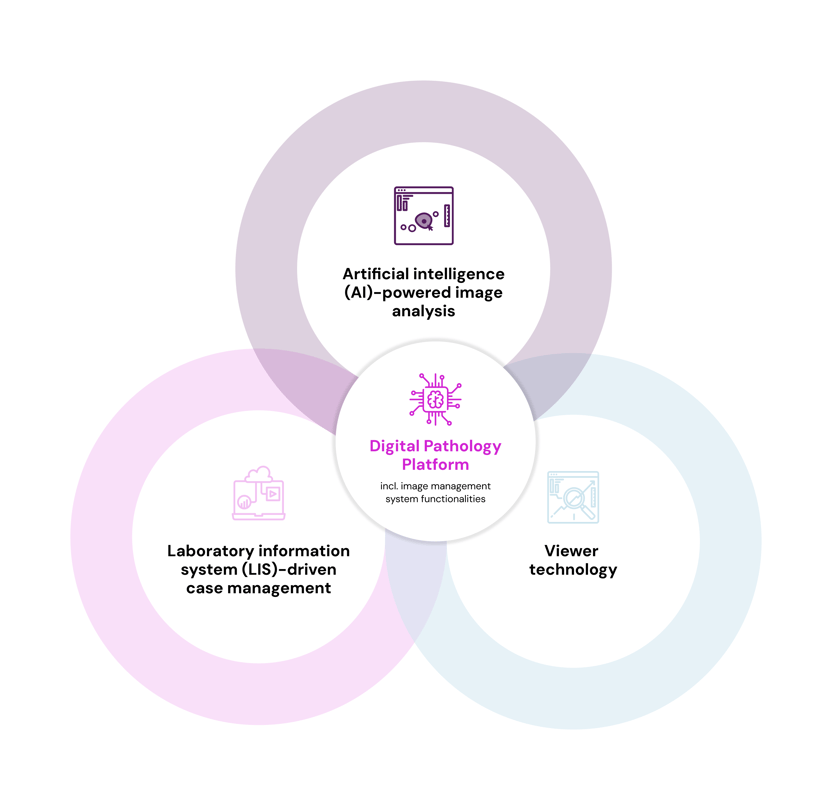
A modern-day digital pathology platform is more than just an image viewer for WSIs (Whole Slide Image). It is the central hub and the intersection where the three core pillars, patient data (LIS), digital slides, and AI diagnostics meet to create a seamless workflow for pathologists.
How to select and compare the digital pathology platforms?
Winter et al. followed a well-defined selection process to ensure only clinically relevant platforms were selected and compared. Out of the vast market, they identified 14 digital pathology platforms that met three (3) strict inclusion criteria:
i) Commercial availability on the European market
ii) Declared CE-IVD status and suitability for diagnostic use
iii) The presence of AI-based diagnostic modules (either native or integrated third-party tools)
To further compare these 14 carefully selected digital pathology platforms, two board-certified pathologists and an IT specialist together defined six (6) core parameters, based on the practical needs of a routine clinical pathology laboratory:
i) Regulatory status to ensure legal compliance for real-world clinical diagnostics
ii) Platform architecture, describing how the system is built and deployed (e.g., cloud vs. on-premise)
iii) LIS integration to assess how well the platform talks to the existing laboratory information system
iv) Viewer and format compatibility to ensure support for various WSI formats, and that the system works with existing slide scanners
v) Third-party integrations to enable the plug-in of external AI algorithms
vi) AI availability, which refers to the platforms’ range of tools available for biomarkers and tumor detection
Aiforia® Platform and the modern digital pathology standards
Based on the evaluation criterion by Winter et al., laboratory managers are encouraged to transition away from isolated, single-vendor applications toward modular, interoperable platform ecosystems that seamlessly bind together regulatory compliance, technical infrastructure, and AI integration.
Among the selected platform solutions, Aiforia® Platform stands out by aligning significantly well with the set comparison criteria, particularly regarding its regulatory readiness and extensive AI model portfolio. The study highlights Aiforia® Platform as a clinical-implementation-ready solution that notably offers the broadest selection of CE-IVD marked AI solutions. Furthermore, Aiforia® Platform meets all the study’s technical benchmarks for cloud deployment and high scanner compatibility.
The study also emphasizes the importance of openness and local support. Aiforia stands out as a future-proof partner that supports the integration of external applications, aligning with the study's recommendation to maintain flexibility as new technologies emerge. Finally, while the researchers underline the need for site-specific IT expertise and local vendor support, Aiforia addresses these operational needs by providing the required technical depth and close partnership support to maintain stable, daily diagnostic operations.
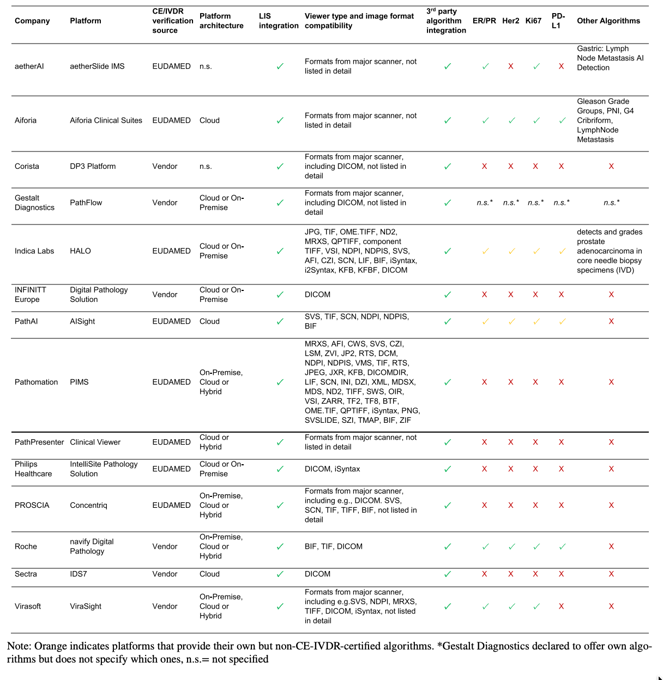
A digital pathology platform comparison matrix from a study by Winter et al. (2026).
Lina Winter, Annalena Artinger, Jan Albin, Cristina L. Cotarelo & Christoph Brochhausen; Digital pathology platforms with integrated AI algorithms: a structured landscape analysis and recommendations for clinical implementation. Virchows Archiv. https://link.springer.com/article/10.1007/s00428-026-04480-8
Evaluation parameters beyond the Winter et al. study – Aiforia's take
While the Winter et al. study provides fantastic baseline recommendations for the evaluation of digital pathology platforms, a sophisticated evaluation methodology requires looking at a few additional parameters:
i) Platform ecosystem and integration
A digital pathology platform is only as strong as its surrounding ecosystem. Seamless integrations with strong and trusted industry partners are essential for ensuring the new software talks effortlessly with the laboratory's existing scanners and LIS, preventing daily workflow bottlenecks.
ii) Heat maps vs. granular AI precision
Not all AI image analyses are equal. While heat maps provide helpful visual guidelines at-a-glance, clinical precision requires pixel-level analysis for accurate quantification of biomarkers. Choosing a platform that identifies, segments, and quantifies individual cells with high-resolution precision is key to improved diagnostic confidence and accuracy.
iii) Reporting and data communication
AI output is only useful if it can be easily communicated and data flows seamlessly to the next stage of patient care. A modern digital pathology platform should provide automated, built-in reporting functions that automatically pull AI findings into a structured format, reducing manual data entry errors and saving valuable time during clinician's sign-off.
Conclusion: select a context-specific, future-proof digital pathology platform
The Winter et al. study underscores that the choice of a digital pathology platform should be based on technical integration evaluation, strong clinical evidence, and context-specific choices. By prioritizing regulatory readiness, open architecture, and a comprehensive portfolio of validated AI tools, pathology laboratories can ensure their transition addresses the increasing workload and growing diagnostic complexity now and in the future.
As laboratories navigate this transformation, the Aiforia® Platform serves as a robust, implementation-ready partner. By closely aligning with the technical and clinical benchmarks defined by Winter et al., Aiforia® Platform supports pathology teams in streamlining their daily workflows and delivering higher-precision care to every patient.

References:
- Winter, L., Artinger, A., et al. (2026). Digital pathology platforms with integrated AI algorithms: a structured landscape analysis and recommendations for clinical implementation. Virchows Archiv. https://link.springer.com/article/10.1007/s00428-026-04480-8