
Clinical

  • Clinical Solutions
  • AI solutions portfolio

Explore Aiforia’s comprehensive portfolio of high-performance AI solutions, engineered for both clinical and preclinical applications. Aiforia’s solutions aim to enhance the speed, accuracy, and consistency of analyzing large and complex medical images, especially in pathology.

Learn more

Research

  • Research solutions
  • Aiforia® Create
  • AI solutions portfolio

Aiforia’s research solutions offer fully automated study-centric workflows and pathology image analysis applications that cater to all research areas. Empowered by robust AI capabilities, pathologists and scientists can make discoveries while saving time by automating repetitive tasks – also within the framework of GLP. Aiforia’s solutions can be integrated with any existing laboratory infrastructure to enjoy the full benefits of a digitized workflow.

Learn more

Aiforia® Create is the most versatile tool for developing deep learning AI models for image analysis in digital pathology. Its cloud-based, collaborative working environment allows multiple users to work together in real time, anywhere in the world. Praised for its intuitive user interface, it allows users a fast start, even without any prior AI experience.Learn more >

Learn more

Explore Aiforia’s comprehensive portfolio of high-performance AI solutions, engineered for both clinical and preclinical applications. Aiforia’s solutions aim to enhance the speed, accuracy, and consistency of analyzing large and complex medical images, especially in pathology.

Learn more

AI development tool

  • Aiforia® Create

Aiforia® Create is the most versatile tool for developing deep learning AI models for image analysis in digital pathology. Its cloud-based, collaborative working environment allows multiple users to work together in real time, anywhere in the world. Praised for its intuitive user interface, it allows users a fast start, even without any prior AI experience.

Learn more

Resources

  • Publications
  • Resource Library
  • Press releases

Explore some of our latest publications showcasing the discoveries enabled by the Aiforia® Platform.

Learn more

Aiforia's insights and resources for AI in pathology. View some of our content pieces from the world of AI.

Learn more

Stay updated with Aiforia’s recent announcements. Explore our latest news, updates and announcements.

Learn more

Company

  • About us
  • Investors
  • Partners
  • Media
  • Events
  • Careers
  • Quality and security

Find out more about shareholder matters, investment discussions, and financial-related information.

Learn more

Aiforia's mission is to transform pathology image analysis with AI, enabling better care for each patient. To succeed, we need our trusted partners. Explore Aiforia’s partner network.

Learn more

Experience our AI solutions firsthand. Explore the list of conferences where you can connect with Aiforia’s team live and book a time to discover the future of AI-powered image analysis.

Learn more

Our mission is to transform pathology image analysis with AI, enabling better care for each patient. Find out more about job openings, thesis opportunities, or submitting applications.

Learn more

Aiforia Technologies holds information security to the highest standard. We hold several, globally relevant quality and security certifications, so you can be sure your sensitive information is safe.

Learn more

Research

Research solutions

Aiforia® Create

AI solutions portfolio

AI development tool

Aiforia® Create

Resources

Publications

Resource Library

Press releases

University of Oulu case study: AI in endometrial cell analysis

Dr. Marika Kangasniemi reflects on using AI in the analysis of endometrial samples from different phases of the menstrual cycle.
Written by Aiforia

PEDEGO, a research unit at the University of Oulu, covers a wide range of topics primarily around pediatrics, obstetrics, and gynecology. The metabolic health group within this unit has several ongoing clinical trials related to reproductive and metabolic health in women, including the function of the endometrium in women with polycystic ovary syndrome (PCOS). PCOS affects 10-18% of fertile-aged women, and many present with complications such as metabolic syndrome and infertility. It is also highly linked to obesity, with diabetes and hypertension as common comorbidities.

The inner lining of the uterus, the endometrium, is a hormone responsive tissue and consists of epithelium tightly connected with underlying stromal cells, allowing for a strong relationship between the layers. Women with PCOS present with an altered endometrial function related to steroid hormones or metabolic issues contributing to infertility. We interviewed Marika Kangasmiemi, MD and PhD student at the University of Oulu, on her experience with Aiforia® Create to study the endometrium in different phases of the menstrual cycle.


Tell us a bit about the project or research work you used Aiforia’s software for

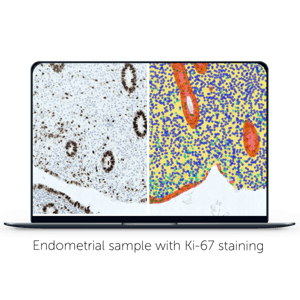
"Endometrial samples from 2 different patient groups and from different phases of the menstrual cycle were analyzed so that endometrial leukocytes and proliferative cells were counted, separately in epithelium and stroma."

What is unique about the project?

"Endometrial tissue is dynamic, and the amount of stroma and epithelium differs a lot between patients and cycle phases; even samples from the same patient are different. Still, those two compartments are very different and cannot be analyzed as a whole one unit. This separation has earlier been very manual and time consuming. Now Aiforia did this automatedly."
Dr Marika Kangasniemi interview


Why did you decide to use Aiforia?

"It was the first deep learning solution that we heard of, and luckily for us, it's originally from Finland, which was also a significant factor. After some preliminary testing this solution seemed to work and we decided to go for it."


How did you find getting started with Aiforia?

"Pretty easy user interface. Still, understanding all image processing terms and their effect on algorithms was quite difficult, but we got help for that from Aiforia staff."

"Aiforia made it possible to analyze hundreds of whole slide images by separating stroma and epithelium and then counting target cells. Manually, the whole project might not have been possible."


Read the full publication here: Artificial intelligence deep learning model assessment of leukocyte counts and proliferation in endometrium from women with and without polycystic ovary syndrome

References

Mayo Clinic. (2021). Polycystic ovary syndrome (PCOS). https://www.mayoclinic.org/diseases-conditions/pcos/symptoms-causes/syc-20353439a