

 Back to all blog posts


Dr. Robert Mozayeni is a physician/researcher in Bethesda, Maryland, where he is a director of the Foundation for the Study of Inflammatory Disease (FSID), Laboratory Director of a high complexity clinical testing laboratory (T Lab Inc.), Chief Medical Office of Galaxy Diagnostics (GalaxyDx.com), and medical director of a private medical practice (Translational Medicine Group). "We are located in the heart of a major biotech region that includes the National Institutes of Health (NIH), the Food and Drug Administration (FDA), and more. I first came to this area to work at the NIH," he explains.
Read Dr. Mozayeni's full interview below related to his COVID-19 research.
Tell us a bit about your work
"My work, in general, is focused on how inflammation may start and persist to cause acute and chronic diseases. More often than not, these diseases result from persisting infection. My work with FSID is to oversee the foundation’s efforts to explore and illuminate the mechanisms of inflammation, how the human immune system becomes dysregulated or overwhelmed, and what we can learn from large sets of clinical data about the patterns of response to the treatment of inflammatory diseases.
In the clinical lab, we have developed advanced microscope imaging tools and other techniques to detect pathogens that cause inflammatory diseases. In my medical practice, I focus on treating patients with chronic, complex, and often debilitating inflammatory illnesses. This work informs the development of diagnostic tests that can be used to guide medical care for inflammatory diseases.
Many of my patients with chronic conditions now also have COVID-19. And many with COVID-19 are developing persisting chronic inflammatory illnesses. Thus, it has become exceedingly urgent for me and others to be able to determine if and how COVID-19 becomes a chronic disease. In patients with other chronic inflammatory diseases, their response to COVID helps us learn more about the pathophysiology of COVID-19, and our understanding of COVID is informed by our prior experience with chronic inflammatory conditions."
Why did you decide to use Aiforia's AI software?
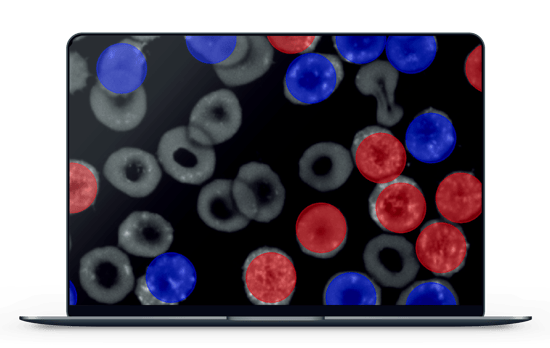
"FSID is positioned to apply aiForward analysis to thousands of high-resolution microscope images of human blood and tissue samples containing specific pathogens (or, for example, the fluorescent tags of bacterial or viral RNA).
FSID has access to large sets of unique images generated by T Lab for such analysis. To date, the visual analysis of such images has been up to teams of expert histopathologists, microbiologists, and microscopists to interpret. We see the potential to train the aiForward system to analyze such images with extreme precision and great efficiency.
Aiforia training thus far will be used as background training to be able to discern patterns of COVID-related disease in microscope images of blood and skin tissues."
Tell us a bit about your proposed project
"As COVID-19 was emerging, FSID laid out a program to analyze high-resolution images of blood and skin samples stained for COVID-19 RNA (and/or inflammatory markers) collected from hundreds of patients, and to put those results in the context of other testing, clinical and medical history data collected about those individuals in order to gain better understanding of the mechanisms and impact of this disease.
When we became aware that Aiforia might be available to generate extraordinary image analysis and high efficiencies, we reached out."
/Other%20medical%20areas/Coronavirus%20before.png?width=300&height=190&name=Coronavirus%20before.png) How is this significant to advancing our understanding of coronavirus?
How is this significant to advancing our understanding of coronavirus?
"Finding COVID-19 and related inflammatory responses anywhere in the body will contribute to our understanding of this virus. Using AI to analyze images of either the novel coronavirus RNA in blood or other tissues, as well as potentially colocating such viral RNA along with markers for immune response, would be a very significant contribution to our understanding of the virus’ behavior, pathogenicity, and potential treatment interventions."
Is there something novel about your proposed research project?
"We see COVID-19 as an inflammatory systemic disease of sudden onset that exerts much of its damage in the vascular system with the formation of clots that impair blood flow. We are focused on the study of COVID in the vascular system and blood components. We are uncovering evidence of COVID-19 RNA in the blood, skin, vasculature, lymphatic system, and other tissues. And in the context of patients’ clinical histories and other test results, these findings may reveal important patterns of immune response and significant opportunities for treatment."
How will AI help advance this?
"Using AI in this process is novel because AI can detect differences that are not obvious to humans. AI has the potential to increase the throughput of specimens to augment the human technologist’s visual analysis of thousands of microscope slides while reducing the inherent variabilities in the process. So, although efficiencies are extremely important, it is the potential ability to detect subtle changes that are not otherwise seen by humans, and ultimately, allow for a big stepwise increase in the sensitivity and specificity."
"The Aiforia team is extraordinary. Not only are they experts who have built amazing technology, but they are also great teachers and passionate about helping their clients succeed. We are thrilled to be working with them."
Read more case studies: