

 Back to all blog posts


Breast cancer remains one of the most significant challenges in modern oncology globally(1). While advanced screening programs and increased public awareness have improved our ability to detect the disease earlier, the biopsy still marks a critical point in patients’ clinical journey. Once a sample is taken, the focus moves toward defining the specific molecular profile of the tumor. This characterization is essential because the precision of the pathological assessment determines how clinicians select the best possible treatment for each individual patient.
Ki-67 proliferation index in breast cancer pathology
Ki-67 is a nuclear protein that serves as a marker for cellular proliferation. It is central to the treatment assessment for breast cancer pathology and is often evaluated alongside other key biomarkers as part of a comprehensive breast cancer panel, such as in Aiforia® Breast Cancer Suite.
To define the Ki-67 score, also called the Ki-67 proliferation index, a pathologist assesses the percentage of tumour cell nuclei showing positive immunohistochemical staining. For clinicians, this percentage is a critical prognostic biomarker. A high Ki-67 score often indicates an aggressive phenotype, which may require chemotherapy. Conversely, a low score might indicate that a patient can safely avoid toxic systemic treatments. Therefore, it is a fundamental decision-making factor that directly influences patient outcomes.
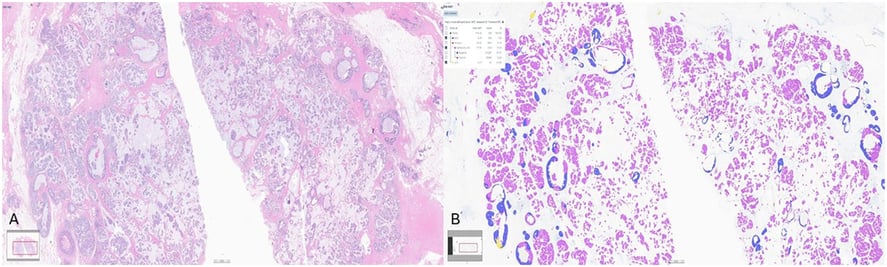
Image from Omar Abdelsadek, Adam Prevost, Britney Fowler, Amy Plagge, Valerie Straubmuller, Zongming (Eric) Chen, Saba Yasir; “Real-World Performance of an Artificial Intelligence Model for Ki-67 Quantification in Breast Cancer: The Mayo Clinic Experience” Laboratory Investigation, 106, Volume 106, Issue 3, Supplement 104374 (March 2026) https://www.laboratoryinvestigation.org/article/S0023-6837(25)00285-5/fulltext
Addressing interobserver variability and time-consuming manual tasks
Despite its importance, Ki-67 scoring has a long-standing reputation for being a bottleneck in the pathology workflow. Traditionally, pathologists estimate the percentage of stained cells either by eyeballing the slide or by manually counting Ki-67-positive cells under a microscope.
The challenge is twofold. First, even highly skilled pathologists may look at the same slide and produce different scores, causing inter-observer variability, leading to differences in diagnosis and treatment decisions. Second, manual cell counting is exhausting and time-consuming, pulling pathologists' expertise away from more complex diagnostic tasks and urgent cases.
Standardizing the Ki-67 scoring is essential for ensuring that every patient receives a consistent diagnosis regardless of which pathology laboratory processes their tissue sample. While these challenges have long been considered inherent to the profession, recent large-scale clinical studies suggest that automated standardization is already a proven practice.
The Mayo Clinic experience – Aiforia® Platform for Ki-67 quantification in breast cancer
A recent retrospective study published in Laboratory Investigation (2026) provides real-world evidence on how we can overcome the traditional hurdles of manual Ki-67 assessment. The study, titled “Real-World Performance of an Artificial Intelligence Model for Ki-67 Quantification in Breast Cancer: The Mayo Clinic Experience”, evaluated the performance of an AI model built within the Aiforia® Platform, implemented in a high-volume clinical setting. Rather than testing the AI model on a selected, perfect dataset, the researchers evaluated its performance over 1,877 real-world breast cancer cases.(2) To summarize the results:
No manual edits:
The Aiforia-built Ki-67 image analysis model performed so reliably that 93% of the cases required no manual edits by the pathologists.
Consistency across subtypes:
This high level of performance remained consistent across all invasive breast cancer subtypes and various clinical scenarios.
Seamless integration:
The Mayo Clinic’s study demonstrates that AI can be integrated into pathology routines, acting as a digital assistant to handle the time-consuming Ki-67 cell counting.
Reduced subjectivity:
AI-assisted scoring helped mitigate the subjectivity typically associated with Ki-67 assessment, producing reproducible and standardized results across the study cohort.
The future of pathology is built on precision
How can we make the subjective objective and accelerate the diagnostic turnaround?
This study from the Mayo Clinic reinforces a clear message: AI-assisted Ki-67 quantification is not a theoretical promise – it is a validated real-world practice. Across 1,877 breast cancer cases, the Aiforia® Create-built model delivered consistent, reproducible scores with minimal pathologist intervention, demonstrating that the subjectivity and workload burden of manual scoring can be meaningfully reduced.
By automating the routine quantification of markers like Ki-67, pathology laboratories can free up expert time for complex diagnostic decisions, improve turnaround times, and increase the reliability of the data guiding treatment plans.
References:
- Sung H, Ferlay J, Siegel RL, Laversanne M, Soerjomataram I, Jemal A, Bray F.
“Global cancer statistics 2020: GLOBOCAN estimates of incidence and mortality worldwide for 36 cancers in 185 countries.” CA Cancer J Clin. 2021:71:209-249. https://doi.org/10.3322/caac.21660 - Omar Abdelsadek, Adam Prevost, Britney Fowler, Amy Plagge, Valerie Straubmuller, Zongming (Eric) Chen, Saba Yasir; "Real-World Performance of an Artificial Intelligence Model for Ki-67 Quantification in Breast Cancer: The Mayo Clinic Experience”
Laboratory Investigation, 106, Volume 106, Issue 3, Supplement 104374 (March 2026)
https://www.laboratoryinvestigation.org/article/S0023-6837(25)00285-5/fulltext
Looking for an AI development tool for your research project?
Visit: https://www.aiforia.com/aiforia-create