

 Back to all blog posts


Estimates of the percentage of large droplet steatosis in the liver are essential for determining the liver organ quality prior to transplantation. According to Dr. Maxwell L. Smith, a pathologist at Mayo Clinic, >30% macrovesicular large droplet steatosis is associated with an increased organ discard rate and poor outcome compared to those with <30%.
In practice, accurately evaluating steatosis in liver pathology is complex and several studies show poor reproducibility among pathologists in estimating large droplet fat (LDF). That’s why Dr. Smith developed an AI model to optimize LDF steatosis estimations and to potentially improve safe organ utilization for liver transplantation.
This case study summarizes Dr. Smith’s presentation at Aiforia’s webinar, “Using AI in anatomic pathology: application to interstitial lung disease and liver transplantation.”
Estimating large droplet fat steatosis is intrinsically complex
Pathologists use different techniques to evaluate steatosis, resulting in inconsistent estimations. A low-power assessment may result in 42% steatosis, while a high-power one might yield 28%.1
These numbers also vary based on whether a pathologist evaluates metrics like:
- Fat droplet size
- Number of cells containing droplets
- Surface area covered by droplets
Dr. Smith explained that pathologists' definitions conflict regarding small or large fat droplets versus “true” microvesicular steatosis. “Pathologists are consistent at estimating steatosis when specimens do not contain fat, whereas their steatosis evaluations of liver specimens containing fat are inconsistent.”
Although guidelines like the Banff consensus recommendations1 may help pathologists improve the consistency of LDF steatosis evaluations prior to liver transplantation, there’s a better way to conduct these estimations more consistently—using AI models.
AI models can recognize and quantitate LDF on preimplant frozen sections
Dr. Smith hypothesized he could build an AI model to recognize and quantitate LDF on preimplant frozen sections of liver biopsies, enabling predictions of patient and graft failure and preservation reperfusion injury prior to transplantation.
Validated AI model functions similarly to human pathologists
Dr. Smith built an AI model using Aiforia® Create, a versatile AI development tool, and trained it to recognize features like dilated sinusoids and vascular spaces as negative annotations since they do not count as LDF. To improve its generalization outcomes, he validated the model on 43 H&E-stained frozen sections selected across a range of steatosis percentages, artifacts, and preparation techniques/quality.
When Dr. Smith’s group validated the AI model using 17 sections, comparing human-to-human versus human-to-AI performance, they did not observe any statistically significant differences between the two groups, indicating that the model functioned optimally, as expected.
AI model optimization to detect key features while excluding others
Upon successfully validating the AI model, Dr. Smith selected 20 sections from the study cohort to test the model for generalization. He noticed he had to re-train it to exclude regions mistakenly recognized as tissue.
Dr. Smith also noticed that many liver specimens contained lipopeliosis (coalesced lipid aggregates), requiring additional model training to detect these regions and accurately capture most of the LDF in the liver samples while excluding sinusoids and vascular spaces.
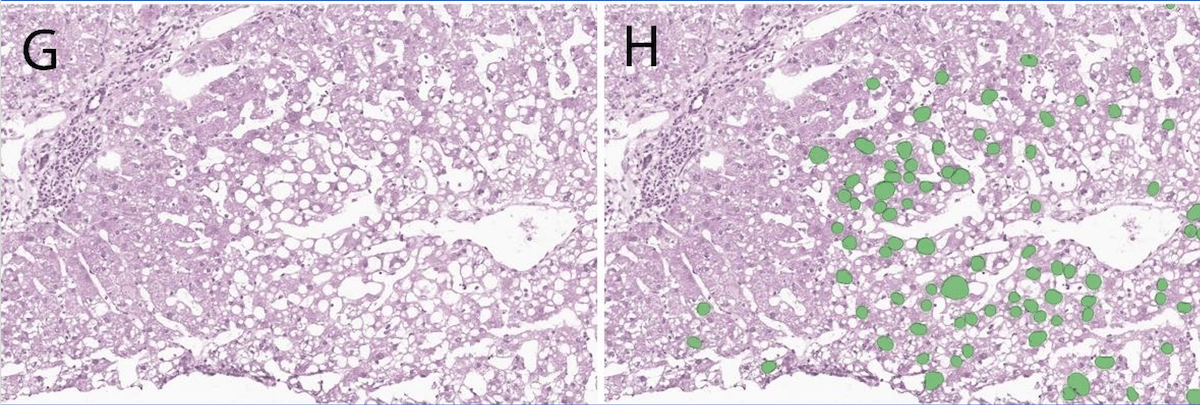
The AI model recognizes most of the large droplet fat but excludes sinusoids
AI can predict adverse outcomes based on LDF quantitation
With the AI model working as expected, Dr. Smith’s group analyzed preimplantation frozen section slides from a pilot study cohort of 161 patients using three approaches:
- Standard, traditional steatosis estimation
- Banff LDF estimation
- Mayo Algorithm (combines percent LDF and lipopeliosis surface area estimations).
Of these approaches, the AI model had the lowest preimplant steatosis percentage or LDF, which was expected as it is well known that pathologists tend to overestimate fat quantities in liver samples. Dr. Smith’s group also observed correlations between AI-detected steatosis and adverse outcomes, such as early allograft dysfunction, respiratory failure, and advanced fibrosis.
However, it is surprising that the AI-detected lipopeliosis did not correlate with any of these adverse outcomes despite a high correlation with patient survival, which is inconsistent with previous findings. Likewise, the AI-detected percent lipopeliosis, but not LDF, correlated with graft failure, whereas both the AI-detected percent lipopeliosis and LDF correlated with patient survival.
Dr. Smith believes expanding their cohort may increase their power for statistical significance. It’s also crucial to perform similar analyses at other institutions and on cases with more significant steatosis to better understand the model’s capabilities.
AI adds more diagnostic value to liver pathology reports
Overall, Dr. Smith is enthusiastic about the benefits of AI models for the future of pathology reporting.
“Digitization is already creating room for more measurements. However, AI allows for more quantitative and reproducible measurement of important histologic features, which adds more value to clinical pathology reports and makes them diagnostically usable for cases like liver transplantation.” – Maxwell L. Smith, MD, Pathologist, Mayo Clinic
Aiforia® Create enables pathologists and other domain experts to build and evaluate deep learning AI models for a wide range of image analysis tasks.
Learn more about LDF estimation using AI models: Watch the full webinar recording
References
1. Neil, D. et al. (2022, April). Banff consensus recommendations for steatosis assessment in donor livers. Hepatology, 75(4), 1014-1025. https://doi.org/10.1002/hep.32208