
Clinical

  • Clinical Solutions
  • AI solutions portfolio

Explore Aiforia’s comprehensive portfolio of high-performance AI solutions, engineered for both clinical and preclinical applications. Aiforia’s solutions aim to enhance the speed, accuracy, and consistency of analyzing large and complex medical images, especially in pathology.

Learn more

Research

  • Research solutions
  • Aiforia® Create
  • AI solutions portfolio

Aiforia’s research solutions offer fully automated study-centric workflows and pathology image analysis applications that cater to all research areas. Empowered by robust AI capabilities, pathologists and scientists can make discoveries while saving time by automating repetitive tasks – also within the framework of GLP. Aiforia’s solutions can be integrated with any existing laboratory infrastructure to enjoy the full benefits of a digitized workflow.

Learn more

Aiforia® Create is the most versatile tool for developing deep learning AI models for image analysis in digital pathology. Its cloud-based, collaborative working environment allows multiple users to work together in real time, anywhere in the world. Praised for its intuitive user interface, it allows users a fast start, even without any prior AI experience.Learn more >

Learn more

Explore Aiforia’s comprehensive portfolio of high-performance AI solutions, engineered for both clinical and preclinical applications. Aiforia’s solutions aim to enhance the speed, accuracy, and consistency of analyzing large and complex medical images, especially in pathology.

Learn more

AI development tool

  • Aiforia® Create

Aiforia® Create is the most versatile tool for developing deep learning AI models for image analysis in digital pathology. Its cloud-based, collaborative working environment allows multiple users to work together in real time, anywhere in the world. Praised for its intuitive user interface, it allows users a fast start, even without any prior AI experience.

Learn more

Resources

  • Publications
  • Resource Library
  • Press releases

Explore some of our latest publications showcasing the discoveries enabled by the Aiforia® Platform.

Learn more

Aiforia's insights and resources for AI in pathology. View some of our content pieces from the world of AI.

Learn more

Stay updated with Aiforia’s recent announcements. Explore our latest news, updates and announcements.

Learn more

Company

  • About us
  • Investors
  • Partners
  • Media
  • Events
  • Careers
  • Quality and security

Find out more about shareholder matters, investment discussions, and financial-related information.

Learn more

Aiforia's mission is to transform pathology image analysis with AI, enabling better care for each patient. To succeed, we need our trusted partners. Explore Aiforia’s partner network.

Learn more

Experience our AI solutions firsthand. Explore the list of conferences where you can connect with Aiforia’s team live and book a time to discover the future of AI-powered image analysis.

Learn more

Our mission is to transform pathology image analysis with AI, enabling better care for each patient. Find out more about job openings, thesis opportunities, or submitting applications.

Learn more

Aiforia Technologies holds information security to the highest standard. We hold several, globally relevant quality and security certifications, so you can be sure your sensitive information is safe.

Learn more

Research

Research solutions

Aiforia® Create

AI solutions portfolio

AI development tool

Aiforia® Create

Resources

Publications

Resource Library

Press releases

Case study: quantitating histopathological features of idiopathic pulmonary fibrosis

Kati Mäkelä, an MD specializing in pulmonary medicine, tells us about using AI to quantitate histopathological features of idiopathic pulmonary fibrosis.
Written by Aiforia

Kati Mäkelä, an MD specializing in pulmonary medicine at the Helsinki University Hospital and a PhD student in the Lung Factor Research Group at the University of Helsinki, is using AI to quantitate histopathological features of idiopathic pulmonary fibrosis (IPF). Read her full interview below. 

Tell us about your research project

"My doctoral thesis focuses on histopathological features of idiopathic pulmonary fibrosis (IPF) and their connection to clinical information of patients with IPF.

The study cohort of the research project originates from the FinnishIPF registry, which is a prospective and multicenter registry study. In this research project, we focused on the prognostic aspects of fibroblast foci, interstitial mononuclear inflammatory cells, and intra-alveolar macrophages in IPF."

Why did you decide to use Aiforia's software?

"We had digitized slides of patients with IPF, of which we aimed to quantitate histopathological features and compare their amount against the data derived from the FinnishIPF registry.

At first, we intended to do this manually and partly with semiquantitative methods. Our collaborator, docent, and pathologist Mikko Mäyränpää, who had previous experience with Aiforia in other projects, recommended Aiforia.

Aiforia allowed us to quantitate wanted features in absolute numbers instead of using semiquantitative methods."

What did Aiforia allow you to do that you could not do with traditional tools?
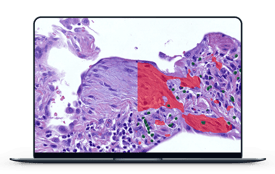
histopathological features of idiopathic pulmonary fibrosis


"The absolute number of inflammatory cells is practically impossible to count manually. In addition, with the layer-based method of Aiforia, we were able to separate interstitial and alveolar inflammatory cells without immunohistochemical staining."


What is the biggest benefit of using AI in your work?

"Learning to use Aiforia was fast and easy, and the staff was very friendly and helpful. We found that the number of inflammatory cells was associated with prolonged survival of patients with IPF; this finding is novel, and without the use of AI, we could not have counted the absolute number of inflammatory cells.

Our finding suggests that AI can provide a new kind of approach when analyzing prognostic aspects of histopathological features in IPF, and perhaps in the future, in other interstitial lung disorders as well."

Read Dr. Mäkelä's publication here →


Review more lung case studies: