Clinical
Explore Aiforia’s comprehensive portfolio of high-performance AI solutions, engineered for both clinical and preclinical applications. Aiforia’s solutions aim to enhance the speed, accuracy, and consistency of analyzing large and complex medical images, especially in pathology.
Learn moreResearch
Aiforia’s research solutions offer fully automated study-centric workflows and pathology image analysis applications that cater to all research areas. Empowered by robust AI capabilities, pathologists and scientists can make discoveries while saving time by automating repetitive tasks – also within the framework of GLP. Aiforia’s solutions can be integrated with any existing laboratory infrastructure to enjoy the full benefits of a digitized workflow.
Learn moreAiforia® Create is the most versatile tool for developing deep learning AI models for image analysis in digital pathology. Its cloud-based, collaborative working environment allows multiple users to work together in real time, anywhere in the world. Praised for its intuitive user interface, it allows users a fast start, even without any prior AI experience.Learn more >
Learn moreExplore Aiforia’s comprehensive portfolio of high-performance AI solutions, engineered for both clinical and preclinical applications. Aiforia’s solutions aim to enhance the speed, accuracy, and consistency of analyzing large and complex medical images, especially in pathology.
Learn moreAI development tool
Aiforia® Create is the most versatile tool for developing deep learning AI models for image analysis in digital pathology. Its cloud-based, collaborative working environment allows multiple users to work together in real time, anywhere in the world. Praised for its intuitive user interface, it allows users a fast start, even without any prior AI experience.
Learn moreResources
Explore some of our latest publications showcasing the discoveries enabled by the Aiforia® Platform.
Learn moreAiforia's insights and resources for AI in pathology. View some of our content pieces from the world of AI.
Learn moreStay updated with Aiforia’s recent announcements. Explore our latest news, updates and announcements.
Learn moreCompany
Find out more about shareholder matters, investment discussions, and financial-related information.
Learn moreAiforia's mission is to transform pathology image analysis with AI, enabling better care for each patient. To succeed, we need our trusted partners. Explore Aiforia’s partner network.
Learn moreExperience our AI solutions firsthand. Explore the list of conferences where you can connect with Aiforia’s team live and book a time to discover the future of AI-powered image analysis.
Learn moreOur mission is to transform pathology image analysis with AI, enabling better care for each patient. Find out more about job openings, thesis opportunities, or submitting applications.
Learn moreAiforia Technologies holds information security to the highest standard. We hold several, globally relevant quality and security certifications, so you can be sure your sensitive information is safe.
Learn moreClinical
Clinical Solutions
AI solutions portfolio
Research
AI development tool
Aiforia® Create
Resources
Company
About us
Investors
Partners
Media
Events
Careers
Quality and security
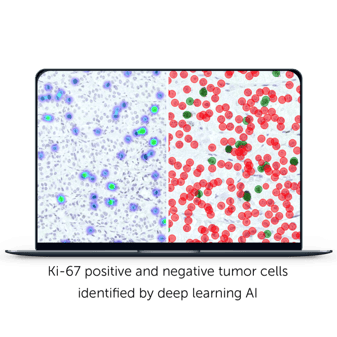
Jenni Säilä, a researcher at the HUSLAB Department of Pathology, working together with her supervisor Tiina Vesterinen, developed a deep learning AI model with Aiforia® Create to quantify Ki-67 positive and negative tumor cells in rare pulmonary carcinoid (PC) tumors as a part of her thesis study.
Ki-67 is a commonly used molecular target in cancer diagnostics, and its proliferation index is an essential parameter in PC tumor diagnostics.
Jenni’s study material consisted of five tissue microarray slides, which included 127 PC tumors. The slides were immunohistochemically labeled with a Ki-67 antibody, and Jenni used the digitized slides to train her own AI model with Aiforia® Create to identify Ki-67-positive and negative tumor cells.
The results Aiforia produced were referenced against a pathologist completing the analysis manually and compared with those produced by non-AI-based image analysis software. The analysis of immunohistochemical stains with these traditional methods is often time-consuming and prone to inter- and intra-observer subjectivity.
”The AI modeI was better at analyzing the samples. You didn’t have to exclude any areas because Aiforia was able to detect everything. Compared to other image analysis methods in which if there are any issues with the samples like staining errors or broken tissue, the other programs are not able to count in these areas,” describes Jenni.
The convolutional neural networks, which power Aiforia’s deep learning AI, allow image analysis to perform at a level far beyond human capabilities. Perfect training material or high quantities of images or slides are not needed to train or create a robust AI model.
Aiforia is also agile in providing a unique image analysis solution, as AI models can be trained to detect any feature in any image. Tiina explains: ”You can’t train yourself with traditional image analysis methods. You can’t fully customize them to meet your needs. With Aiforia, you have the control; you can improve and adapt the methodology to find exactly what you are looking for.”
”Our aim is to use this AI algorithm also in clinical diagnostics to assist pathologists. Since preliminary results are promising, we plan to train the algorithm further to calculate Ki-67 proliferation index also for other neuroendocrine tumors,” Tiina concludes.
Read more case studies: