

 Back to all blog posts


Aiforia is helping advance cancer research at MIT
Non-small-cell lung cancer (NSCLC), a heterogeneous class of tumors, accounts for about 85% of all new lung cancer diagnoses. The laboratory of Tyler Jacks at MIT developed a widely used mouse model that allows for detailed analysis of these tumor types. However, these experiments generate a large number of histopathological samples which demand careful and labor-intensive quantitation of tumor grade and burden. Thus, there was an urgent need to assess the tumor pathology in a scalable manner beyond the capability of an individual technician.
Peter Westcott, a postdoc in the Tyler Jacks lab explains how time-consuming these analyses were with traditional, manual methods: “It was challenging, it is a very heterogenous model. Even within each grade, there is a huge amount of variability.”
“You get 50 or so tumors per mouse and have to hand annotate and hand grade those, so it was a really laborious process. This would take maybe an hour per mouse or more,”
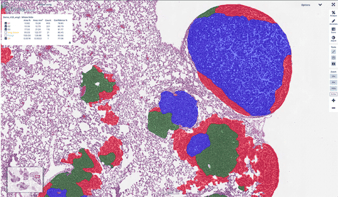 A previous postdoc from his lab had started to work with Aiforia in the software’s early stages to create an automated algorithm to perform this tumor grading. Peter then took over and started working with Aiforia's scientists. “The platform has made huge strides, a huge boost in quality. What really struck me was that there is really user feedback. You can see how the algorithm performs in your training regions or on separate annotation regions and you can really see where it is making mistakes with the error percentage shown. I think that is a really novel system,” Peter explains.
Only half the number of total slides analyzed were needed for training the AI models, and only a few regions off each slide. “Aiforia is non-subjective. It normalizes this important metric across the lab and between labs. There is subjectivity between people. Everyone is grading slightly differently, which is not ideal. This, Aiforia, standardizes the grading system.
Comparing results between people is very doable, whereas previously it was not possible,” Peter explains the benefits he encountered in using Aiforia. “It can also reveal new things we did not see before. Tumor heterogeneity, for example, can be seen in areas of different grades in one tumor. It certainly makes the process easier to study these.” The Aiforia® Platform has now become the “best practice” in the MIT lab.
Read more lung case studies: