

 Back to all blog posts


According to WHO, there were more than 1.4 million new cases of prostate cancer in 2020. It is the second most common cancer in men, and it caused more than 375,000 deaths globally in 2020. 1 Early intervention based on correct characterization of the tumor is a key element of treatment planning and survival. 2
As the analysis of biopsies is time-consuming and prone to interobserver variability 3, computational pathology and artificial intelligence (AI)-based tools have become invaluable for achieving time-savings and objective diagnosis.
Marika Karjalainen, a doctoral student at the Doctoral Programme in Clinical Research, University of Helsinki, presented a poster at the European Congress on Digital Pathology 2024. In their study, she and her team compared the results of an AI-assisted image analysis of prostate cancer cases to those made without assistance.
This article explains their study design, results, and conclusions. For more details and graphs, view the full poster: Aiforia® Clinical Suite for Prostate Cancer: A Holistic Assistive Tool for Prostate Cancer Diagnostics.
Study design
The team used Aiforia® Prostate Cancer Suite in their study, which consists of AI models for image analysis and a matching Aiforia® Clinical Suite Viewer. It produces automated analysis detecting tumor epithelium, Gleason patterns, length measures, and adverse findings from H&E-stained prostate biopsy slides.
For the study, whole slide images (WSIs) of routine H&E slides from 111 prostate cancer patients were digitized. The images were analyzed in two independent rounds: with and without the assistance of the Aiforia® Prostate Cancer Suite (4-week washout period), and a variety of statistical characteristics were calculated. Seven WSIs were also analyzed by 148-150 pathologists in 15 countries, and the consensus was compared to the AI-assisted result.
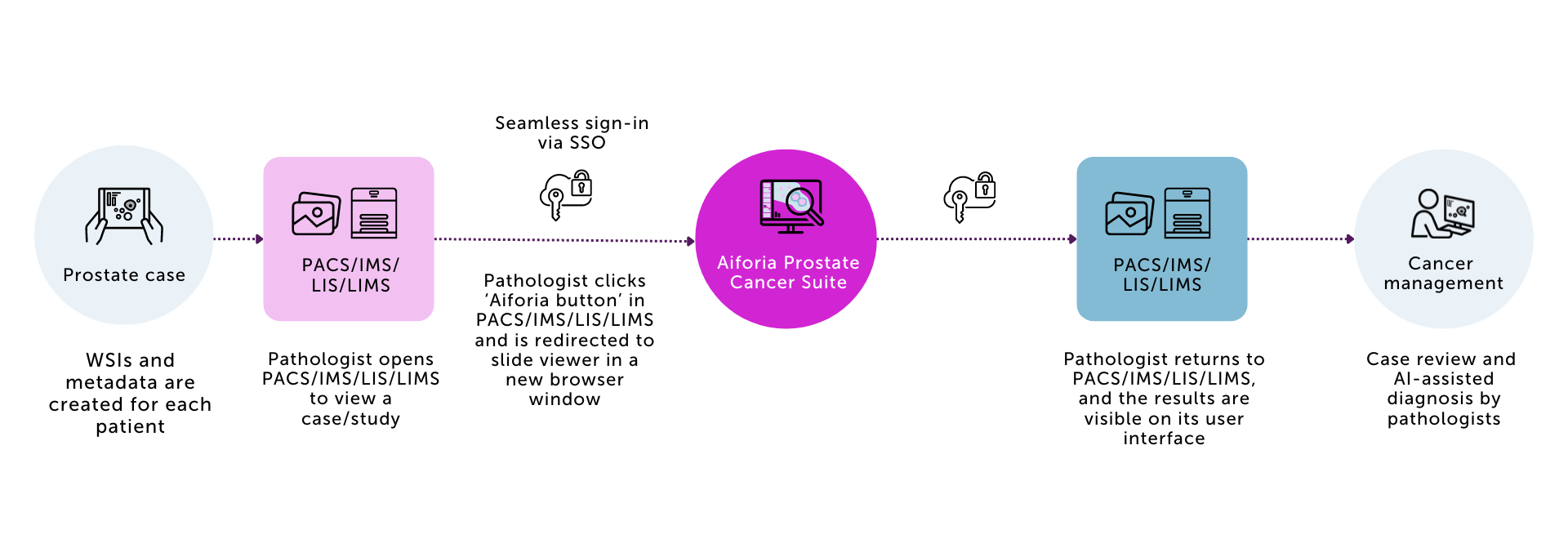 Prostate cancer pathology workflow with Aiforia® Prostate Cancer Suite
Aiforia® Prostate Cancer Gleason Grade Groups is CE-IVD marked for diagnostic use in EU and EEA countries. The measurement of tissue and tumor lengths and the performance of the adverse findings are in the last phases of clinical validations, currently for Research Use Only (RUO).
Study results
AI-assisted Gleason grading is very well in concordance with the analysis performed without assistance.
The model can predict positive observations with a 96.8% recall ratio for the combined dataset, ranging from 93 to 100% for individual pathologists. Precision ranged from 86.9 to 93.9% per pathologist, being 89.8 % for the combined dataset. Overall accuracy (F1) ranged from 89.8 to 96.6% per pathologist, being 93.2% on average.
The reliability of agreement between visual diagnosis and AI-assisted diagnosis was 0.846 (Cohen’s weighed kappa) for the combined dataset, and the range for pathologists was 0.788-0.878.
Time spent for Gleason pattern analysis per slide was significantly reduced during AI-assisted diagnosis; on average, each slide took 34% less time (p < 0.05).
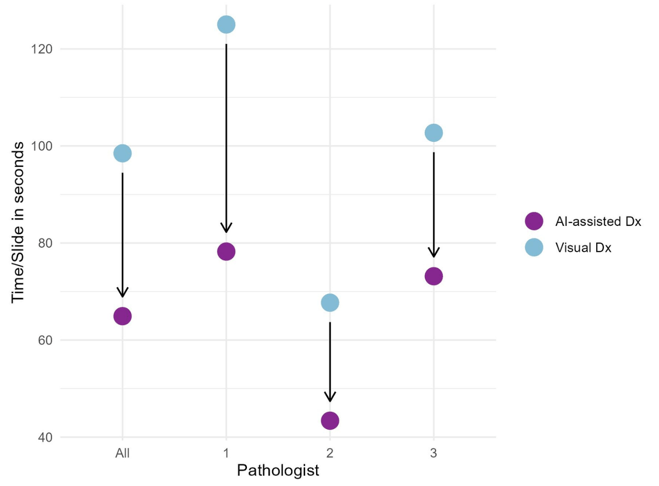
Time per slide in seconds: AI-assisted diagnosis versus visual diagnosis
Interobserver study indicates that the variance between pathologists is wide. Although the standalone AI-result is mostly in good concordance with the consensus, interpretations for the grade grouping cause further disparity to the diagnoses.
The benefits of AI
The team found that AI-assisted support can reduce inter-observer variability among pathologists and that Aiforia Prostate Cancer Suite may serve as a second opinion or triage tool for medical centers.
To conclude, AI-assisted analysis has the following benefits:
- Improved treatment efficacy with more precise diagnosis
- Faster time to diagnosis and less waiting time for patients
- Samples are reviewed consistently and efficiently, ensuring everyone is treated the same
- Time savings and reduction in error while improving treatment accuracy results in faster work and lower costs
Going forward, digital tools and automated workflows can significantly reduce the increasing burden of prostate diagnostics.

References
- Cancer Today - IARC. (2023, February 2). Online analysis table. WHO. https://gco.iarc.fr/today/
- Mohler, J. et al. (2019). Prostate cancer, version 2, NCCN clinical practice guidelines in oncology. J. Natl Compr. Canc. Netw. 17, 479–505.
- Melia J. et al. (2006, May). A UK-based investigation of inter- and intra-observer reproducibility of Gleason grading of prostatic biopsies. Histopathology, 48(6), 644-54.