

 Back to all blog posts


Translating images into new discoveries with deep learning AI
Dr. Leena Strauss, a lecturer and researcher at the University of Turku’s Institute of Biomedicine, has taught disease model pathology for the past decade. She is one of the first adopters of digitizing teaching in pathology. “I wanted to be ‘on the front line’ in teaching as well,” she describes. After using Aiforia to take her images online and standardize course materials, she decided to explore Aiforia’s deep learning AI.
Leena’s research focuses on the action of sex steroid hormones in a broad range of diseases, from reproductive disorders to metabolic syndromes. She has taken a particular focus on estrogen and uses genetically modified mice as models for human diseases. In the female mouse the estrus cycle corresponds with the human menstrual cycle. Following the estrus cycle over a long period of time will reveal much about the reproductive function of a mouse.
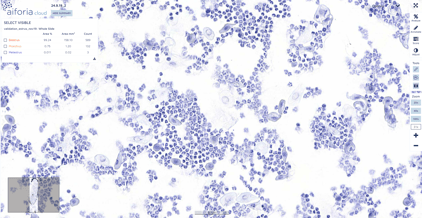
Diestrus phase of the cycle visualized on Aiforia
Microscopic challenges
The stage of the estrus cycle can be determined by cytology through the microscopic examination of vaginal smears from mice. This is a time-consuming process as many of Leena’s studies involve high numbers of mice and many samples over many weeks.
Leena recently started working with one of the scientists at Aiforia to automate this image analysis process with deep learning AI. When asked if she knew much about AI before embarking on this project, Leena explained that she had taken an online course through the University of Helsinki to help her understand the basics, but actually using AI was new to her.
Creating AI models without coding
With 300 slides hematoxylin stained, digitized, and ready to go Leena has already started to create her own deep learning AI models with Aiforia® Create.
“I was afraid that it would be too difficult for me. Luckily, I was wrong,” she explained. Aiforia’s cloud-based solution enables healthcare professionals to train and create their own deep learning models without any coding.
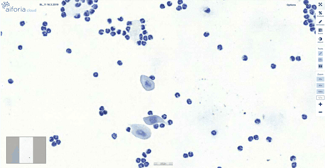 By automating this burdensome image analysis work, Leena not only looks to accelerate her research but also perhaps expand her findings. The samples collected in these studies are often not explicit. Certain features or patterns are difficult for the human eye to discern on its own. With deep learning AI beginning to surpass our own capabilities, the expectation is that the AI models Leena creates will help her speed up the discovery.
Find the official publication here →
Read more Aiforia case studies:
- MIT case study: advancing lung cancer research with AI
- CRL case study: AI-assisted screening of bone marrow cellularity changes
- Faron Pharmaceuticals case study: using AI to perform spatial analysis in cancer drug development