

 Back to all blog posts


Bone marrow cellularity is the volume ratio of hematopoiesis (the body’s manufacturing of blood cells) and fat, and it decreases with age. Many compounds can alter the cellularity of bone marrow, making it a vital tissue for pathologists to analyze in pharmacologic safety studies. Quantitative data is vital for statistical evaluation in risk and toxicity assessments.
AI provides objectivity
However, the important analytical information of these studies is often represented by images, which lack unambiguous and objective criteria for analysis as interpretation of these images is largely affected by the experience of the researcher. Specialists in toxicology are often also not trained in translating results into mathematical statistical models, while specialists in mathematical statistics and modeling lack knowledge of the specificity of risk assessment and methods in toxicology.
AI models provide a more objective quantification of bone marrow cellularity and increase the reliability of image analysis by evaluating a larger area and providing accurate cell counts compared to a pathologist’s subjective severity score. Objective data is also statistically analyzable to evaluate against other study data, and the nature of AI model generation for image analysis allows for continuous improvement of the AI model with new training data.
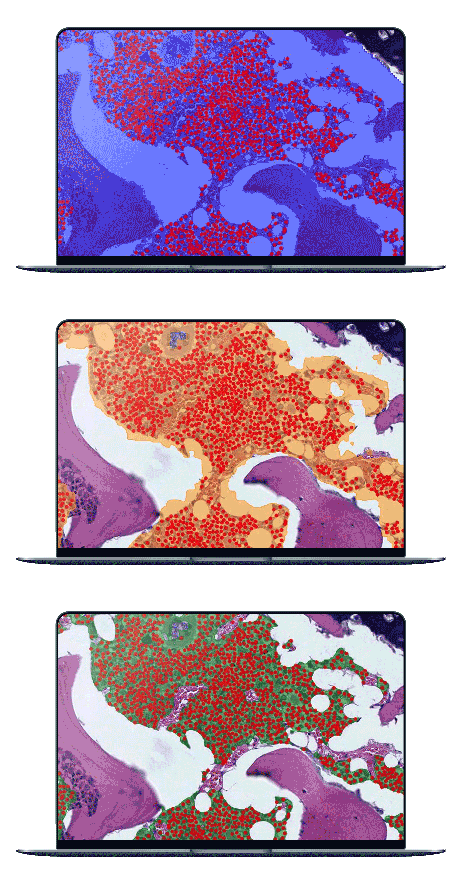
A research team at Charles River Laboratories (CRL) developed an AI model with Aiforia® Create to evaluate whole slide images of macaque sternebrae to identify and enumerate bone marrow hematopoietic cells. The AI model was trained to differentiate the hematopoietic cells from the other sternebrae tissues and serves as an objective measure of bone marrow cellularity in tissue sections. Learn more from Mark Smith, PhD VMD, Veterinary Pathologist at CRL, in his interview below and from this on-demand webinar.
Review the full publication: Screening for bone marrow cellularity changes in cynomolgus macaques in toxicology safety studies using artificial intelligence models
Tell us a bit about the project or research work you used Aiforia for
Mark Smith: "Bone marrow is a standard tissue for analysis in pharmacologic safety studies.
Xenobiotic compounds can alter the cellularity of bone marrow. Anatomic pathologists evaluate bone marrow in hematoxylin and eosin-stained bone sections, diagnose increases or decreases in cellularity, and assign a subjective severity score. We felt an Artificial Intelligence model might be able to determine cellularity in a more objective manner and serve as a screening tool to alert study pathologists to changes in bone marrow cellularity.
What is unique about the project?
"There is no current AI model that quantifies the number of cells in the bone marrow from a histologic section."
Why did you decide to use Aiforia?
"The Aiforia® Platform is cloud-based and accessible without the need to install software and was fairly easy to learn."
How did you find getting started with Aiforia?
"After an hour or so of instruction, training the model was straightforward, as was subsequent troubleshooting to improve it. In short, it was a smooth start."
What is the biggest benefit of Aiforia to your work?
"The model will provide useful data on bone marrow cellularity, which can be used to screen slides and draw attention to potential lesions. A similar effort by a pathologist would be very time-consuming and not practical."
References
Ignatova, A. & Zemlyanova, M. (2020, November 10). Proceedings of the 8th scientific conference on information technologies for intelligent decision making support (ITIDS 2020). Atlantis Press. https://doi.org/10.2991/aisr.k.201029.068
Smith, M. et al. (2021, January 5). Screening for bone marrow cellularity changes in cynomolgus macaques in toxicology safety studies using artificial intelligence models. Sage Journals. 49(4). https://doi.org/10.1177/0192623320981560
Weng, C. et al. (2015, February 24). Bone marrow pathology predicts mortality in chronic hemodialysis patients. BioMed Search International. https://doi.org/10.1155/2015/160382