

 Back to all blog posts


HER2 is a receptor for human epidermal growth factor, which promotes tumor cell growth, proliferation, and invasion. It is amplified in about 15% to 20% of breast cancers, making its status pivotal in treatment decisions.1,2 HER2 status is used both as a predictive factor for treatment and a prognostic factor for survival in breast cancers. Utilizing HER2 status to assign proper treatment has dramatically improved the overall survival of patients with HER2-positive breast cancer who previously had a poor prognosis3.
The exact treatment regime of HER2-positive breast cancer depends on multiple clinicopathological factors, but blocking HER2 function either by a therapeutic anti-HER2 antibody or by small molecule drugs is a key component in targeted therapy of HER2-positive breast cancer. Let’s explore the topic in more detail.
Defining HER2-low and HER2-ultralow breast cancer
HER2 overexpression and amplification are tested by immunohistochemistry (IHC) and in situ hybridization (ISH) assay, respectively. The algorithm for interpreting IHC staining results is based on the abundance and intensity of membranous HER2 expression in invasive tumor cells. The final score is IHC 0, IHC 1+, IHC 2+, or IHC 3+. An ISH assay is needed in case the IHC assay is equivocal (IHC 2+). The result for ISH is typically either positive or negative, although ISH may yield equivocal results if the copy number of the HER2 gene is low.
In the current and well-established binary classification paradigm, only IHC 2+ (ISH+) and IHC 3+ are considered HER2-positive results, and IHC 2+ (ISH-), IHC 1+, and IHC 0 are considered HER2-negative. Based on the binary classification, about two-thirds of breast cancers are considered HER2-negative4. However, the majority of the HER2-negative patients actually show low HER2 expression4, which has warranted studying whether this patient population may benefit from anti-HER2 treatment. A growing pool of evidence shows that HER2-low breast cancer, i.e., IHC 1+ and IHC 2+ (ISH-), is a clinically significant and actionable finding, paving the way toward the new paradigm introducing the HER2-low class5.
Furthermore, within the HER2-low patient population, HER2-ultralow is another emerging and potentially clinically significant subpopulation falling between the truly negative (IHC 0) and IHC 1+ classes.6 In HER2-ultralow cases, ≤10% of invasive tumor cells show incomplete and weak HER2 staining.
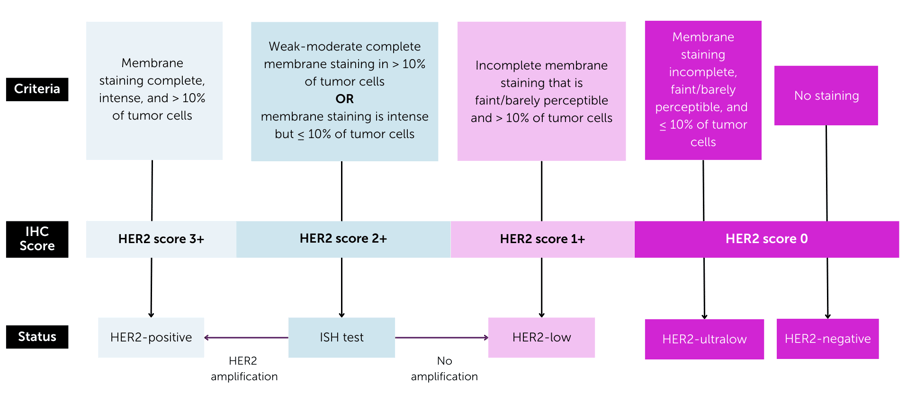
HER2 assessment: criteria, IHC score, and status
Detecting HER2-low: challenges and assisting tools
One of the critical challenges with detecting HER2-low is high intra-observer variability: the ability of a single pathologist to evaluate and read whole slide results consistently. Similarly, high inter-observer variability is seen between multiple pathologists, leading to reduced reproducibility of HER2 testing.7-9
AI assistance makes the analysis consistent, as it does not suffer from these variabilities. AI also counts all cells in the whole specimen without exhaustion and provides pathologists with quantification of HER2 expression across all tumor cells. Furthermore, AI assists the pathologist in reporting by pre-filling the report for the pathologist to review and approve.
As the name implies, AI-assisted analysis is meant to assist the pathologist in the analysis, reducing the time needed per case. AI is not an independent decision-maker; the pathologist is always in full control, approving the final results.
Given that traditional analysis methods are laborious and prone to observer variability, as well as the various benefits of deploying AI in the pathology workflow, AI-based image analysis will surely serve as a gold standard reference in the field in the near future.
Aiforia® Breast Cancer HER2
Aiforia has the most comprehensive breast cancer offering on the market for AI-assisted image analysis. Aiforia® Breast Cancer Suite consists of multiple AI models and a matching Aiforia® Clinical Suite Viewer that support the histological grading of breast cancer, and the detection of invasive carcinoma and scoring of Ki67, ER, PR, and HER2.
The AI model for HER2 analysis, Aiforia® Breast Cancer HER2, supports HER2 scoring based on College of American Pathologists (CAP) guidelines in whole slide images (WSI). It also supports the assessment of HER2-low and ultralow cases.
Pathologists can benefit from:
- Transparent results: The user can review and verify the AI model output on top of the original image and edit the analysis results and the report
- Automated reporting of HER2 expression at the slide level
- Smooth workflow and user experience – enabled by the timely analysis of results
Aiforia® Breast Cancer HER2 is CE-IVD marked for diagnostic use in EU and EEA countries (IVDR) and for Research Use Only (RUO) and Performance Studies Only (PSO) in all other market areas.

References
1. Slamon et al. (1987). Human Breast Cancer: Correlation of Relapse and Survival with Amplification of the HER-2/neu Oncogene. Science, 235(4785), 177-182. https://doi.org/10.1126/science.3798106
2. Andrulis et al. (1998). neu/erbB-2 amplification identifies a poor-prognosis group of women with node-negative breast cancer. JCO, 16(4), 1340-9. https://doi.org/10.1200/jco.1998.16.4.1340
3. Baselga, J. (2001). Clinical trials of Herceptin (trastuzumab). European Journal of Cancer, 37(1), 18-24. https://doi.org/10.1016/S0959-8049(00)00404-4
4. Schalper, A., Kumar, S., Hui, P., Rimm, D. & Gershkovich, P. (2014). A retrospective population-based comparison of HER2 immunohistochemistry and fluorescence in situ hybridization in breast carcinomas: impact of 2007 American Society of Clinical Oncology/College of American Pathologists criteria. Arch Pathol Lab Med, 138(2), 213-219. https://doi.org/10.5858/arpa.2012-0617-oa
5. Tarantino et al. (2020). HER2-Low Breast Cancer: Pathological and Clinical Landscape. JCO 38(17), 1951-1962. https://doi.org/10.1200/jco.19.02488
6. MacNeil et al. (2020). New HER2-negative breast cancer subtype responsive to anti-HER2 therapy identified. J Cancer Res Clin Oncol. 146(3), 605–619. https://doi.org/10.1007/s00432-020-03144-7
7. Bianchi et al. (2015). Accuracy and Reproducibility of HER2 Status in Breast Cancer Using Immunohistochemistry: A Quality Control Study in Tuscany Evaluating the Impact of Updated 2013 ASCO/CAP Recommendations. Pathology & Oncology Research, 21, 477-485. https://doi.org/10.1007/s12253-014-9852-0
8. Fernandez et al. (2022). Examination of Low ERBB2 Protein Expression in Breast Cancer Tissue. Jama Oncology, 8(4), 607-610. https://doi.org/10.1001/jamaoncol.2021.7239
9. Robbins, C. J., Fernandez, A. I., Han, G., Soong, T. R., Reisenbichler, E. S., & Rimm, D. L. (2023). Multi-institutional Assessment of Pathologist Scoring HER2 Immunohistochemistry. Modern Pathology, 36(1). https://doi.org/10.1016/j.modpat.2022.100032