

 Back to all blog posts


Introduction
Analyzing three dimensional objects has always been a challenge for researchers who wish to find truthful, unbiased information. This is true especially in the field of neuroscience, where the investigator is often faced with detailed networks of cells in expansive areas. The number one tool enabling this analysis for the past few decades is stereology. Regarded as time efficient and effortless, it applies fundamental principles of geometry and statistics to analyze 3D objects. However, the statistical methods allow for only partially examining the region of interest (ROI) and deducing the rest of the information accordingly.
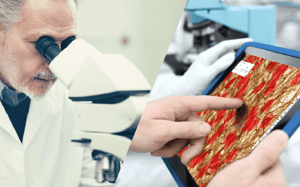 Advances in deep learning artificial intelligence (AI) are remodelling image analysis within the medical sciences. By scanning digitized whole slide images (WSIs), the examination of 2D pictures can be automated with AI based image recognition applications such as the Aiforia® Platform. These methods bring about a new way of extracting data from 3D objects. Yet as for all novel techniques it poses a set of new challenges. Here we aim to lay out the challenges and benefits of both stereology and the Aiforia Platform, using neuroscience as an example.
Challenges of stereology
The number one challenge in stereology is the random variance caused by subsampling of images. Even if the statistical methods used in the process are standardized, random sampling within the ROI will always create variation in the results. For example, counting dopamine neurons from random areas within a tissue section results in variance in cell count estimates between independent observers.
Though sampling in stereology is time efficient compared to how long it would take for the individual to examine the ROI in its entirety, it is still a time-consuming and tedious task to be done manually, making it prone to human error. Besides the problems that come along with sampling for the stereological analysis, the means for extrapolating data from these samples is a source of bias. The logic of how to get from the sampling data to the final conclusions about the ROI might vary between independent researchers and projects.
Deep learning AI for image analysis
Can deep learning AI overcome the limitations related to the use of stereology? Firstly, we need to take a look at the principles of how this novel image analysis application functions. The Aiforia Platform’s workflow begins with a tissue image which the user annotates with the intent of teaching the software some assumed ground truth about the sample, such as how astrocytes look. The AI then works with the pixels within the marked areas, making a general determination about what parts of any sample resemble what we see in those areas. This case-specific AI model can then be used for further analysis, like finding the amount of dopaminergic neurons within the substantia nigra in the cross section of a midbrain.
There are multiple advantages in using an automated image analysis approach over using conventional tools for the job. Major benefits include speed, scalability, and improved statistical accuracy. Releasing some of the burden of image analysis from the shoulders of the researcher will save him or her a lot of time, and the number of images the software can handle is unlimited. Neuroscientist Fredric Manfredsson, currently based at Barrow Neurological Institute, recently compared Aiforia to stereology using 360 slides for analysis. “It would have taken 6 months with stereology. Aiforia did this in a few days,” explained Fredric.
The automated image analysis model also lets the researcher explore the whole ROI in a short period of time. This removes the variance caused by independent observers with differing samples, giving a more statistically precise measure. The possibility to account for the whole ROI also removes the problem of having to find a truly random way of sampling data from the region. Once the AI model is created it will function in the same way every time it is used, making the analysis completely reproducible. So, even though the AI powered workflow involves human guidance making it prone to some bias, the consistent nature of the AI model will produce only systematic errors. Lastly, the deep learning algorithm gives out numbers on accuracy of the analysis, such as counting errors and reliability of results, providing the user with more insights into the process.
Challenges of AI
Deep learning AI for image analysis poses its own challenges. For example, the AI model works with a digitized image, preferably a WSI, which needs to be scanned with a device intended for that purpose. The user needs to acquire this equipment and learn how to use it, a level of effort is needed. Secondly, most of the currently used AI models analyze 2D images and are thus not necessarily fit for drawing conclusions about the 3D body. For instance, neurons often have long protrusions that occupy a large space. This makes it hard to evaluate numeric values about the 3-dimensional structures of single neurons, based solely on the results acquired from the 2D pictures.
Counting cells in every slice of a sample will also result in an overestimation of the cell number in the 3D space, as cut cells will be visible in more than one section. Both cases need additional analysis in order to give a precise estimate of the underlying truth. However, the statistically precise values acquired by the AI model are a good starting point for such an analysis. The tools for the job can be integrated in the software, giving the user all that is needed to use the acquired data in the most efficient way.
Conclusion
Stereological methods are an efficient and widely used means of analyzing three dimensional bodies. Many neuroscience researchers are very comfortable with this technique; therefore, the adoption of an alternative technology can be difficult. However, as digitalization is accelerating rapidly in the field of medical image analysis it is becoming clearer that new tools and techniques are becoming desirable particularly as they continue to improve.
References:
Schmitz, C. and Hof, P. (2005). Design-based stereology in neuroscience. Neuroscience, 130(4), pp.813-831.
Penttinen, A., Parkkinen, I., Blom, S., Kopra, J., Andressoo, J., Pitkänen, K., Voutilainen, M., Saarma, M. and Airavaara, M. (2018). Implementation of deep neural networks to count dopamine neurons in substantia nigra. European Journal of Neuroscience, 48(6), pp.2354-2361.
C., Cheong, D. and Volkmann, J. (2017). Stereological Estimation of Dopaminergic Neuron Number in the Mouse Substantia Nigra Using the Optical Fractionator and Standard Microscopy Equipment. Journal of Visualized Experiments, (127).
www.stereology.info