

 Back to all blog posts


Neurodegenerative diseases are a growing burden for our aging population. Two researchers, each running their own labs at the University of Helsinki in Finland, are addressing this by studying the biological mechanisms of these diseases with the ultimate goal of developing effective therapies. Merja Voutilainen and Mikko Airavaara are both based at the Institute of Biotechnology, and the focus of their research groups is on developing novel treatments for Parkinson’s disease.
Counting is key
Counting is key in neuroscience research. This is particularly true for investigating therapeutic molecules for Parkinson’s disease. It is crucial to be able to accurately quantify the number of neurons in the substantia nigra area of the brain in order to determine the neuroprotective efficacy of these molecules. “We have experienced some challenges when quantifying dopamine cells from the substantia nigra,” Merja explains.
“The current method is very limited by the time required to use the microscope and it is very limited on training a student in this and depends on how well and who trains the student. The variability between the persons to count the neurons is an issue,” Mikko adds. Manual stereology is the current gold standard method in counting different types of neural cells. However, not only is it time consuming, it also renders variable results as it does not allow for full areas to be analyzed but rather data is extrapolated from a few different spaces.
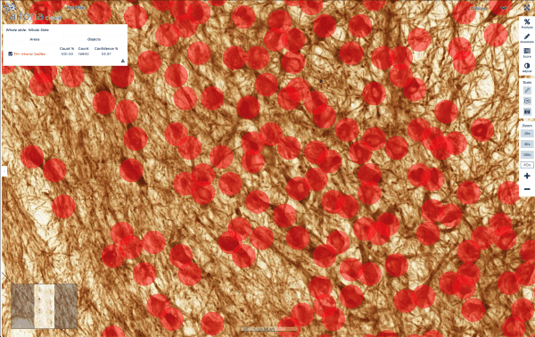
Instant results with AI
Driven by a need for enhanced tools to overcome these challenges, Merja and Mikko started a collaboration with Aiforia. They scanned brain samples from experimental animal models of Parkinson’s disease treated with the molecule under investigation and uploaded these to the Aiforia Cloud. Aiforia® Create was then deployed to quantify the dopamine neurons in their samples. “The results are given instantly,” exclaims Mikko. A typical research project in his lab would usually consist of analyzing 100 to 200 slides, with 6 to 12 sections per slide; this would take weeks or months to quantify the amount of cells.
“With stereology, it would have taken 45 minutes to count the neurons in one nigra area; with Aiforia, it took only 5 seconds.”
Not only was the analysis almost 99% faster, but “the benefit of this system is that the analysis also stays the same and is consistent,” Merja explains. “The results are also presented in both a numerical and visual format. The benefit for our researchers is that they can dedicate their time to other important matters,” Mikko adds.
As more of these barriers and challenges are overcome, neuroscience researchers are advancing closer to finding effective therapies for Parkinson’s and other neurodegenerative diseases. Aiforia aims to support these investigators by providing access to deep learning AI software that can automate image analysis tasks, enabling faster and more accurate research.
Read more neuroscience case studies:
- Case study: AI-assisted image analysis of neurodegenerative disease markers
- Case study: benefits of AI in Huntington's Disease image analysis